



- At the last Governing Council meeting of the year, the ECB unsurprisingly decided to keep its key interest rates unchanged (deposit facility rate at 2%). Furthermore, the decision was unanimous.
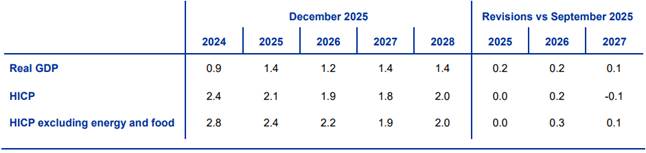
- To explain its decision, the Frankfurt-based institution once again raised its growth forecast for the Euro Area (see below), highlighting the stronger performance of consumption, investment and exports (despite the shock of US tariffs, possibly linked to increased demand for weight loss drugs). At the same time, it stressed that there were more risks to inflation (inflation forecast revised upwards in 2026, downwards in 2027, see also below).
o In particular, Christine Lagarde’s comments revealed that the ECB is payingclose attention to wage dynamics, which have surprised on the upside since September (annual change of + 4 % for 2025 compared with + 3.6 % initially forecast in September), pushing services inflation up over the period as well (annual change in the consumer price index of + 3.5 % in November compared to + 3.1 % in August).
o However, the simultaneous decelerating goods inflation (+ 0.5 % year-on-year in November) is allowing total inflation to remain at the ECB’s current target. - Beyond, the ECB is maintaining its monetary policy approach unchanged, relegating forward guidance to the past. Decisions will continue to be taken meeting by meeting, and will remain data dependent. In this regard, Christine Lagarde emphasizes that all options remain on the table with regards to key interest rates going forward, given the high level of uncertainty. The ECB is not pre-committing to any predefined path for interest rates, and the three-pronged approach of inflation outlook and surrounding risks, underlying inflation dynamics, and the transmission of monetary policy decisions to the real economy remains in place.
- We have taken the following key points from Christine Lagarde’s press conference:
o It appears that European growth has entered a new, more dynamic phase, driven by investment, which the institution did not initially anticipate. Furthermore, this investment boom appears to be widespread and not limited to the public sector.AI seems to be playing a decisive role in this, but this will need to be confirmed over time. In any case, this observation seems to bring discussions about the theoretical neutral rate back to the forefront, even though it is not observable. Christine Lagarde therefore prefers not to dwell on the subject.
o The ECB remains steadfast in its commitment to its mandate and the European treaties. In particular, with regard to the ongoing discussions on the financing of aid to Ukraine or the use of frozen Russian assets in this context, the ECB has no comments to make. Furthermore, the monetization of public debt is prohibited by Article 123 of the Treaty on the Functioning of the European Union.
o The ECB is also not in a position to comment on the ongoing discussions regarding the succession of Christine Lagarde as its President (whose term runs until October 2027). In this regard, Lagarde herself has nevertheless indicated that, while in the past lawyers refuted the idea that members of the ECB’s Executive Board could become President, it would be useful for them to rule on the matter again (thus ruling on Isabel Schnabel’s current candidacy, for example).
Our opinion :
The ECB’s decision to keep its key interest rates unchanged in December comes as no surprise to us. We continue to believe that with a deposit facility rate now at 2%, the ECB finds itself in a comfortable position with inflation stabilized at its target as it allows it to avoid falling back into negative real interest rate territory. This decision also came as no surprise to the markets, which maintained their expectation that the deposit rate would remain at 2% in 2026.
Looking ahead, our forecast remains unchanged: we continue to believe that the ECB will keep its key interest rates unchanged in 2026. Given the high level of uncertainty, this forecast will of course be updated in light of future macroeconomic and geopolitical developments, but there is no reason for it to change in the absence of a significant shock.